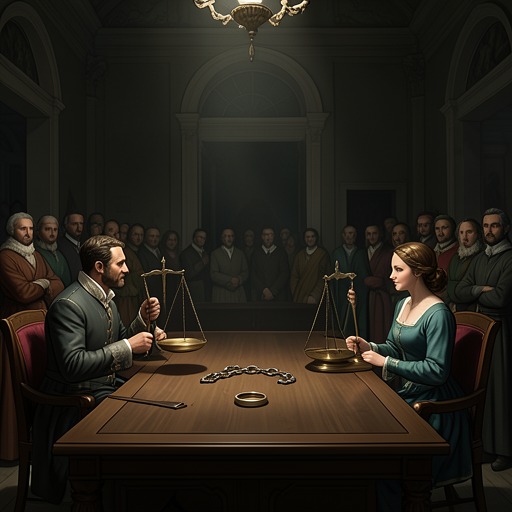
Walter
The Canterbury TalesWalter, the Marquis of Saluzzo, is the youthful ruler whose authority, marriage, and treatment of Griselda organize the central moral conflict of his story. He is introduced as lord of the noble region of Saluzzo, inheriting rule from worthy forebears and commanding the obedience of the land. Yet his position is marked from the beginning by a serious defect: although he is described as discreet in the manner expected of a lord, he gives no thought to what the future may bring. His failure is therefore not simple incompetence, but a ruler’s willingness to treat the future as though it were answerable to his present will.
Identity and Rule
Walter’s public identity rests on hereditary authority. A marquis had once ruled all Saluzzo, as his worthy ancestors had done before him, and Walter continues that inherited sovereignty. The region is presented as noble and filled with grand sights, giving his title a setting of established dignity rather than accidental power. His subjects are obedient to his command, so the social order around him confirms his authority at every level: land, lineage, and public submission all appear to validate his judgment.
That judgment is nevertheless qualified by the narrator’s criticism. Walter is youthful, discreet, and lordly in the expected sense, but he is blamed for failing to consider future consequences. This contrast governs his characterization. The qualities that make him appear fit to rule in public do not guarantee prudence in intimate life. His story asks what happens when a man accustomed to obedience assumes that private relationships can be managed by the same command that governs a realm.
Marriage as Personal Sovereignty
Walter’s approach to marriage makes his conception of authority explicit. He declares that he will choose his own wife and shoulder that burden himself. Marriage is thus presented not as an arrangement in which counsel, mutuality, or social expectation limits the ruler, but as a responsibility he claims as his personal prerogative. His language combines ownership and obligation: because he is the lord, he insists that the decision belongs to him, while also presenting the decision as a burden only he can carry.
This choice has consequences beyond the household. Walter’s marriage becomes a test of whether sovereign power can be transferred into domestic life without becoming tyranny. By choosing for himself, he places his wife under a standard that he alone defines and can alter. The arrangement makes Griselda’s obedience appear to be the condition of marital order, while Walter’s authority remains largely unexamined until his conduct produces public outrage.
Griselda and the Tests of Power
After Walter marries Griselda, she bears a daughter. The child’s birth is noted at a moment when a son had been preferred, but the daughter’s arrival does not diminish the importance of the marriage or the expectations attached to it. Griselda becomes a figure admired by the people, described in their eyes as heaven-sent, someone able to save them and turn wrong to right. Her public reputation therefore contrasts sharply with the private vulnerability created by Walter’s authority.
Walter’s treatment of her eventually becomes notorious. The scandal spreads far and wide because he is understood to have acted wickedly and with a cruel heart toward the poor woman he married. The scandal is intensified by the social imbalance in the marriage: Walter is the marquis, while Griselda is marked by poverty. His conduct is not merely a private failure of affection. It is the abuse of a ruler’s power against someone whose lowly position makes resistance difficult and whose goodness increases the moral ugliness of the tests imposed upon her.
The narrative’s central reversal comes when Walter finally recognizes the extent of Griselda’s wifely steadfastness. He feels pity for her, and this pity changes the emotional value of the scene: what had been an apparently relentless exercise of domination turns toward acknowledgment and release. He tells Griselda that enough has been endured and asks her to cease being displeased and afraid, praising her faith and benignity. His words mark a movement from testing to recognition, but the recognition arrives only after suffering has already exposed the cost of his authority.
Public Scandal and Private Recognition
Walter’s reputation is divided between his formal status and the judgment produced by his conduct. As marquis, he commands obedience; as husband, he becomes the subject of widespread condemnation. The spread of the scandal shows that his actions cannot remain confined to the household. The ruler’s private behavior becomes a public moral fact, and the people’s response supplies a counterweight to his unilateral power.
His pity is therefore significant but limited. Walter does not begin as a character who openly questions the legitimacy of his command. Instead, the narrative brings him to recognition through the spectacle of Griselda’s steadfastness and the social consequences of his cruelty. His change is less a transformation into an entirely different man than an awakening to the human meaning of what he has done. The same authority that caused the ordeal is finally used to stop it, creating an uneasy restoration rather than a simple vindication.
Narrative Role and Significance
Walter functions as the governing force of Griselda’s story and as its principal test of the relationship between sovereignty and service. His decision to choose his wife, his neglect of the future, the birth of his daughter, the scandal surrounding his treatment of Griselda, and his final expression of pity form a causal sequence in which authority repeatedly produces vulnerability before belatedly acknowledging it.
His characterization is deliberately shaped by contradiction. He is a noble ruler who lacks foresight, a discreet lord whose conduct becomes cruel, and a husband who claims responsibility while imposing the consequences upon another person. The story does not allow his final pity to cancel the earlier imbalance of power. Instead, Walter’s arc makes visible how easily a socially accepted right to command can become an instrument of emotional destruction, and how recognition, even when genuine, may come only after the person subjected to power has already borne the full burden of its abuse.